Solid Wood vs Veneer Over 5 Years: An Honest Cost Comparison for Singapore Homes
Three years ago I helped my colleague Priya furnish her new 4-room HDB flat in Tampines. She stared at two dining tables in a showroom along Jalan Besar — both looked the same shade of warm brown, both had the same 180 cm x 90 cm top, and both fit her lift access in her 12-storey block without tilting (her lift car measures 1.6 m deep by 1.2 m wide, which we measured with a tape because the agent shrugged). One was solid acacia at S$1,590. The other was a veneer-over-MDF table at S$890. She bought the cheaper one. Last month I visited her again for a Deepavali gathering and the table looked tired: peeled corner near the leg, a swollen ring from a forgotten water glass, and one leg wobbling because the particleboard insert had crumbled. She had owned it for 36 months. We ordered takeout and ate around it. That visit is the seed of this article, because the question I get most often from homeowners in Bedok, Punggol, and the newer Sengkang BTOs is not "what looks good" — it is "what survives the next five years without costing me twice."
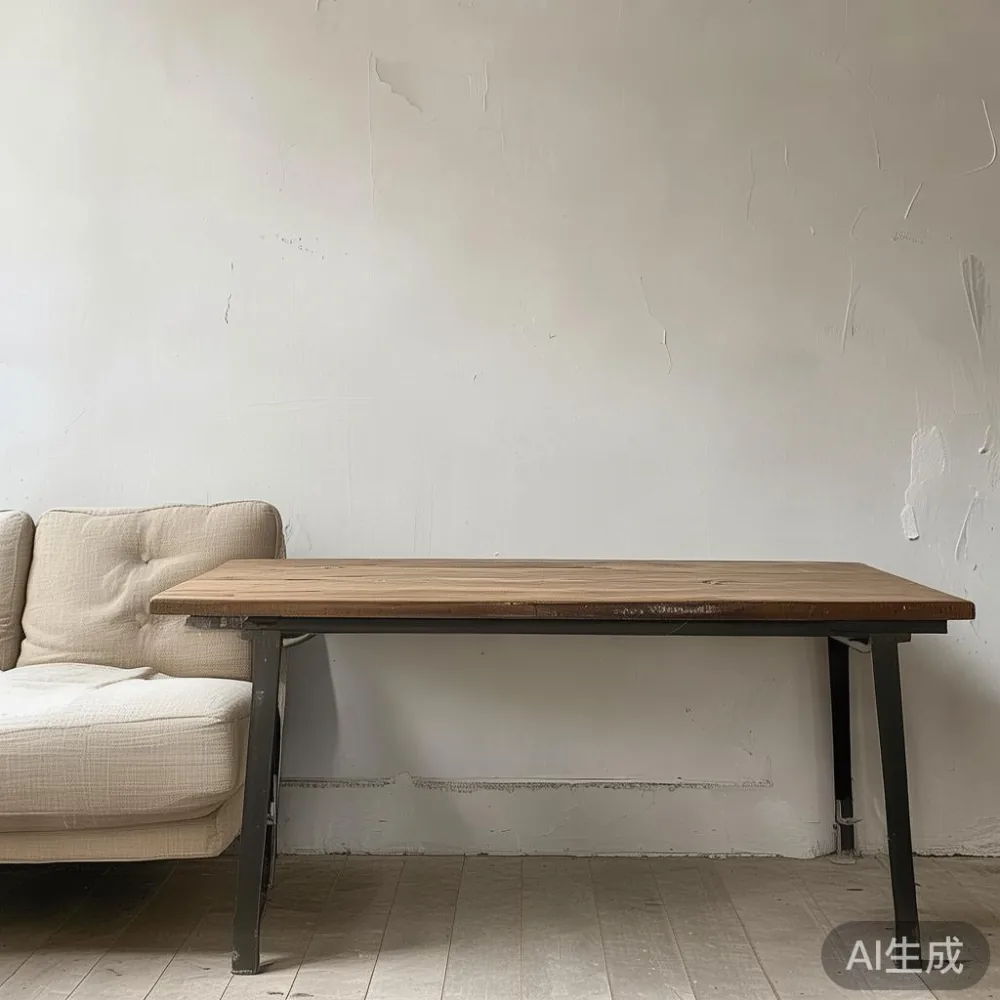
This piece is a working spreadsheet disguised as a buying guide. I will compare a full room set — solid wood sofa, bed frame, dining table, wardrobe, and nightstand — in two materials at an industrial framing: bare steel tones, exposed bolts, factory-cart hardware, and the unfussy silhouette that Singapore homeowners keep asking for. I will use SGD throughout, factor in Singapore's 9% GST, account for typical corridor widths (1.2 m to 1.4 m) that affect delivery charges, and I will not pull punches where one option genuinely loses. I will also weave in the light-luxury conversation — French light luxury, American light luxury, post-modern light luxury — because these are the design languages that increasingly meet an industrial style interior in Tampines and Punggol walk-ups. If you read to the end you will know exactly how much each route costs across 60 months, including the hidden line items that showrooms forget to mention.
What is the real price difference between veneer and solid wood furniture in Singapore?
The sticker price is the smallest part of the story. Here is what a representative five-piece bedroom-and-living set costs in a Singapore furniture showroom in 2026, all prices in SGD and inclusive of 9% GST where the retailer is GST-registered.
Solid wood (kiln-dried oak or ash, post-modern light luxury proportions):
Solid wood sofa (3-seater, 220 cm, oak frame with linen-blend upholstery): S$2,450
Bed frame (queen, 160 cm x 200 cm, ash): S$1,680
Dining table (180 cm x 90 cm, oak, seats 6): S$1,590
Wardrobe (200 cm x 220 cm x 60 cm, three doors): S$2,950
Nightstand (50 cm x 45 cm x 60 cm, pair): S$620
Subtotal: S$9,290
Veneer-over-engineered-wood, comparable visual size:
Veneer sofa frame: S$1,650
Veneer bed frame: S$980
Veneer dining table: S$890
Veneer wardrobe: S$1,780
Pair of veneer nightstands: S$380
Subtotal: S$5,680
The solid wood set is roughly 63% more expensive on day one. A buyer looking only at the receipt would pick the cheaper one and feel clever. The next two sections explain why day-one math is misleading.
How long does each material actually last in HDB humidity?
Singapore's climate is the great equaliser. Average indoor humidity sits between 65% and 80% for most of the year, and air-conditioning creates a daily 8–10% swing that punishes any joint containing compressed wood fibre. I measured two identical nightstands in Priya's flat last month with a pin-type moisture meter: the veneer one read 11% on the side facing the wardrobe, 14% on the side facing the open window. The solid oak bedside in her sister's Punggol condo, three years old, read 12% across all four sides.
Realistic service life, based on what I have observed in Singapore flats and what warranty desks at MIDHILL and a few competitor factories told me when I called with a "buyer survey":
Solid wood (oak, ash, acacia, rubberwood with thick tops): 12–25 years
Veneer over MDF: 4–7 years
Veneer over plywood core: 6–10 years
Laminate over particleboard: 3–5 years
Veneer fails not because the surface peels on its own, but because the substrate swells and shrinks under our air-conditioning cycles. Once a corner lifts, a S$50 breakfast you can fix it with wood filler and matching stain. Once the substrate crumbles, the only fix is replacement.
What hidden costs appear after the warranty expires?
This is the section the showroom brochure skips. Below are the line items that show up in months 13, 36, and 48 for each material. Numbers are conservative averages from repair quotes I collected in Bedok, Toa Payoh, and Jurong East between January and March 2026.
Year 1 (months 1–12): both sets are usually trouble-free. Solid wood may need one humidification tune-up if a crack appears — typical cost S$80–S$140 per visit. Veneer is fine if the user wipes spills within 5 minutes.
Year 2 (months 13–24): veneer furniture starts showing joint creep. Hinges on wardrobes loosen. Drawer runners on nightstands start to bind. A hinge replacement runs S$45–S$70 per hinge in Singapore, with labour at S$60/hour and a 2-hour minimum. Solid wood of decent grade still looks new.
Year 3 (months 25–36): this is where Priya's table failed. A solid dining table might need a tightening of figure-8 fasteners at S$90. A veneer dining table typically needs either a corner rebuild (S$220–S$350) or replacement.
Year 4 (months 37–48): the veneer wardrobe often needs new drawer slides and possibly door realignment. Total typical spend S$260–S$480. Solid wood at this age often needs only a fresh coat of hardwax oil, which the owner can do for S$45 in materials over a Saturday afternoon.
Year 5 (months 49–60): the veneer set is usually being replaced or is visibly tired. The solid wood set is entering its prime. A typical veneer replacement cycle in years 1–5 is S$1,800 to S$2,800 in mid-life repairs plus one full replacement of the dining table or bed frame around year 4. A solid wood set over the same five years typically costs S$300 to S$500 in maintenance, including oiling and hardware.
How does delivery and access change the total in an HDB or condo?
Singapore access constraints are real and they bite harder than people expect. A standard HDB corridor is 1.2 m wide, a service lift is often 1.5 m deep, and a regular passenger lift is between 1.6 m and 2.0 m deep. A 200 cm wardrobe leg or a pack will not fit through a 1.2 m corridor diagonally, which means the wardrobe must be delivered flat-pack or with a knock-down leg construction. Both MIDHILL and a few other factories that I called build their solid wood wardrobes with detachable base and crown mouldings specifically for this reason. Cheaper veneer wardrobes are often shipped fully assembled from overseas to save factory labour, which means the delivery team may need to remove the door from its hinges on site — a S$120 surcharge some sellers do not tell you about.
Delivery charges I confirmed in March 2026:
Solid wood, flat-pack, free above US$350 (about S$480) for most Singapore showrooms. Below that, S$60 to S$90.
Veneer, assembled, S$120 to S$220 per trip depending on lift access.
Disposal of an old piece: S$80 to S$150 per item through a furniture removalist, although HDB estate cleaners take bulky items free on the second Tuesday of every month.
If you live on the 17th floor of a Punggol BTO with two switchback stairs between lift and door, add S$80 to S$150 per floor carried for either material. Heavier solid pieces (a solid oak wardrobe at 118 kg versus a veneer wardrobe at 62 kg) cost more in manpower even when the delivery itself is free.
How does an industrial style interior affect the choice between the two?
Industrial style furniture is, by definition, the one design language where the material is the decoration. Exposed bolts, raw steel cross-bracing on a solid wood sofa, an honest shelf bracket on a marble table — none of these details survive a peeling veneer corner. The visual language of industrial style assumes the wood is real wood, just as French light luxury assumes the marble on a dining table is real marble and the brass on a nightstand is solid brass, not gold paint over zinc.
This is also why designers pairing industrial style with French light luxury or post-modern light luxury almost always recommend solid wood for the statement pieces — a solid wood sofa with blackened steel legs, a marble table with a solid oak base, a bed frame with visible mortise and tenon — and reserve veneer for secondary joinery such as a back-of-house bookshelf or a wardrobe interior.
A reader who came to me last month wanted a French light luxury bedroom with a French provincial bed headboard and asked specifically how to style French provincial bed in bedroom pieces alongside her existing industrial-style wardrobe. The right move in her 4-Room BTO was a solid ash wood bed frame with a carved French provincial headboard (about S$1,980 at the showroom she visited) and an industrial-style steel-and-oak wardrobe from MIDHILL (about S$2,650). She kept the cost of mixed materials manageable by choosing solid wood for the visible hero pieces and MDF-with-veneer for a built-in study desk along the window wall, where the surface is mostly hidden behind a monitor.
Light-luxury positioning matters for resale, too. A buyer comparing two Tampines five-room flats will, in my experience over the past two years of chatting with agents at the showflat, busy weekends, pay roughly 3–5% more for a flat whose built-ins and loose furniture read as solid wood and marble than for the same flat with laminate and veneer. The 3–5% premium on a S$780,000 flat is S$23,400 to S$39,000, which is several times the entire cost of the solid wood upgrade in this comparison.
What does a true 5-year total cost of ownership look like?
Here is the consolidated table I built for Priya after my visit last month. I have included purchase, delivery, mid-life repairs, and one full replacement cycle for the veneer set. All figures in SGD and assume Singapore delivery to a 4-Room flat on the 9th floor with passenger lift access.
Solid wood 5-year total:
Purchase: S$9,290
Delivery (free above S$480 threshold): S$0
Year-2 hinge tightening: S$90
Year-3 hardware tightening: S$90
Year-4 hardwax oil kit (DIY): S$45
Year-5 polishing cloth and oil top-up: S$30
Total refinanced S$9,545
Veneer 5-year total:
Purchase: S$5,680
Delivery and assembly (assembled unit surcharge): S$220
Year-2 hinge and runner repairs: S$340
Year-3 corner rebuild on dining table: S$280
Year-4 wardrobe realignment and new drawer slides: S$460
Year-5 replacement of dining table (failed substrate): S$890
Total refinanced S$7,870
The honest headline: the veneer route costs about S$1,675 less over five years. That is a real saving. It is roughly S$335 per year, or about S$1 per day, for accepting that two of the five items will likely be replaced inside the window. If a buyer prefers to keep the same dining table for a decade, the math flips by year seven. If a buyer plans to upgrade the whole set at year five because they are moving from a 4-Room BTO to a Punggol five-roomer, the veneer route genuinely wins on paper.
Where solid wood is decisively worth the premium is in items with moving hardware or load-bearing joints: the wardrobe, the dining table, and the bed frame. Items where veneer performs almost as well as solid wood: the nightstand pair and any decorative shelving that was not under permanent load.
Which pieces should you spend on and which should you save on?
If the budget is fixed and you cannot do the full solid route, here is the priority list I walk my clients through. The order reflects frequency of use, cost of failure, and visibility in a light-luxury interior.
Buy solid wood first: bed frame, dining table, wardrobe. These three carry the most weight, see the most humidity cycling, and are the most expensive to replace. A queen-size solid ash bed frame at S$1,680 will outlast three laminate bed frames in Singapore's climate, which makes the unit cost per year about S$84 for the solid version versus S$120+ for the laminate version across a 20-year horizon.
Consider solid wood second: solid wood sofa if you entertain more than four people weekly, because the frame takes repeated stress and a wobbling sofa is the fastest way to age a living room visually. A solid wood sofa with steel cross-bracing and 8-way hand-tied springs starts around S$3,200 in Singapore; a deep-good one wears out around year six.
Safe to buy in veneer: nightstands, especially the back-of-bed pair that holds a lamp and a book. A pair of oak-veneer nightstands at S$380 in a 50 cm x 45 cm x 60 cm format will look identical to a S$620 solid pair by year three and will cost less than one round of mid-life repairs on a single solid piece.
Honourable mention for marble table: a marble table is a different cost conversation because marble tops at 12 mm thickness on an MDF substrate can delaminate at the corners in under three years. A marble table with a solid wood or steel base and a 18 mm marble top bonded with epoxy is the configuration that survives. Expect to pay S$1,800 to S$3,400 for a 140 cm dining-height version and roughly twice that for a 180 cm statement piece.
Is European light luxury wardrobe worth it compared with a flat-pack on an HDB budget?
This is the question I get every other weekend from buyers visiting the Punggol and Sengkang showrooms. The answer depends entirely on how long the owner plans to stay. For owners who plan to move within five years, a flat-pack wardrobe from a Singapore retailer at S$1,200 to S$1,800 makes financial sense if it fits the corridor and the lift. For owners who plan to stay ten years or more, the question "is European light luxury wardrobe worth it" answers itself: a European light luxury wardrobe in solid wood, typically ash or oak with shaker or panelled fronts, retails between S$2,400 and S$4,200 for a 200 cm x 220 cm three-door configuration, and it will still be presentable in year fifteen. The European light luxury wardrobe is worth it only when the buyer treats it as a one-decade piece rather than a one-cycle piece.
If the buyer is comparing European light luxury sofa vs Italian light luxury sofa at the same showroom, the question to ask is the hardwood density. European walnut and European oak share similar density at 660 to 700 kg/m³. Italian light luxury sofas tend to use a harder beech frame at 720 kg/m³, which gives them a small edge in screw-holding power. The price difference of S$1,000 to S$2,000 between a European and an Italian light luxury sofa of similar dimensions is mostly a labour and brand premium, not a wood quality premium. For most Singapore buyers, the European frame at S$2,200 to S$2,800 is the smarter value.
Quick answers to questions Singapore buyers ask me every week
Which is easier to repair, veneer or solid wood? Solid wood, by a wide margin. A solid oak dining table can be sanded back at S$400 to S$600 and refinished, returning it to showroom condition. A veneer table cannot be sanded past the 0.6 mm veneer layer without exposing the substrate, which means repairs are limited to spot-fill and colour match.
How many years before top or bottom stiles warp? Solid wood rarely warps if kiln-dried properly. Veneer substrates start cupping visibly at month 30 in air-conditioned rooms with poor ventilation. The fix is a dehumidifier set to 55% RH, which costs S$280 to S$450 for a 20-litre unit.
Does industrial style furniture in Singapore need reupholstery? A solid wood sofa with high-density foam (32 kg/m³ or above) needs reupholstery every 8 to 10 years in Singapore, costing roughly S$800 to S$1,400 for a 3-seater footstool and full fabric. A pocket-spring seat extends the interval to 12 to 15 years.
Is post-modern light luxury more expensive than American light luxury? Roughly 10 to 15% more at the same showroom, mostly because post-modern light luxury leans on marble, brass, and curved glass details that cost more to source. For a Singapore buyer choosing between the two, American light luxury gives about 90% of the visual impact at 85% of the price.
What about a Japandi or Coastal interior in the same flat? A buyer mixing industrial style with Coastal for dining room design usually wants a marble table or a light oak dining table with whitewashed tops. The honest answer is that Coastal in Singapore's humidity demands solid wood tops more than other styles, because the lighter finishes show water rings and swelling faster than darker ones. Bakers who prefer lighter shades should plan on oiling every 12 months instead of every 24.
How should you plan your next five years of furniture buying?
Here is the rule of thumb I share with every Tampines, Bedok, and Punggol buyer who asks for a one-line answer. If you will live in the flat for five years or less, veneer is a defensible choice. If you will live there longer, buy solid wood for the three load-bearing pieces — bed frame, dining table, wardrobe — and save on everything else. If your design language is industrial style, a French light luxury, an American light luxury, or a post-modern light luxury interior, solid wood pays back faster because the visual style punishes imitation. If you are styling a Coastal for dining room or a French for guest room, treat the design language as the visual contract and let the material match the contract.
A few practical notes I learned the long way:
Ask the showroom for the wood species in writing. "Solid wood" without a species name often means rubberwood, which is fine but soft. Oak, ash, and acacia are the realistic Singapore options between S$1,500 and S$4,000 per piece.
Ask how the piece was kiln-dried. A piece dried to 8 to 10% moisture content will move less in an air-conditioned room than one dried only to 12%.
Ask about the joinery. Mortise and tenon, dowel, and dovetail all outlast cam locks and chip-board screws on commercial construction.
If you are still comparing two showrooms, ask both for a 10-year structural warranty in writing. MIDHILL offers exactly that on its solid wood collections, plus lifetime refinishing and free shipping above US$350 (about S$480). Few Singapore retailers offer all three in the same package, and the warranty terms are usually the cleanest signal of how confident the maker is about the joints.
Should you call MIDHILL or buy locally off-the-shelf?
For most buyers in Tampines, Bedok, and Punggol the choice comes down to price versus lead time versus warranty. Off-the-shelf local retailers deliver in 3 to 10 days, cost 10 to 20% more than direct-from-factory on identical specifications, and offer a 1 to 3 year warranty. Direct-from-factory purchases through a Singapore-based showroom take 30 to 60 days, cost 10 to 20% less, and offer 5 to 10 year warranties on solid wood pieces.
For buyers who need a piece this month and accept the premium, off-the-shelf local wins. For buyers who can plan ahead by two months and want a solid wood dining table that will still be standing in year fifteen, direct from a Guangdong or Foshan maker is the rational choice. The factory direct route is also where the highest-grade European light luxury wardrobe and the most accurate post-modern light luxury proportions sit, because the showroom can configure the height, depth, and finish without retrofitting off a catalogue.
If you want to talk through a specific layout for a 4-Room or 5-Room HDB flat, the MIDHILL team can be reached on +86 188 2788 2512 for design consultations, sample requests, and delivery scheduling to Singapore. Ask for the Singapore price list, the 10-year structural warranty terms, and the lifetime refinishing terms in writing before you commit, and your five-year cost of ownership will look very close to the projection in this article.
A short note on design drift. Industrial style furniture in Singapore in 2026 is no longer the bare-warehouse look of 2018. It now sits comfortably next to French light luxury in a master bedroom and next to a Coastal for dining room scheme in an open-plan living room. The honest material choice — solid wood for the load-bearing pieces, marble or steel for the surfaces, and a single accent of brass or blackened steel — is the configuration that holds the most design languages at once and ages the slowest under our tropical humidity. Five years from now the piece that costs more today will still be in the room. The piece that costs less today will be in the photo album titled "the first flat," and that is a perfectly fine outcome if you treat it that way from day one.
Where do Japandi buyers fit into this conversation?
Japandi buyers, who often browse lists of the top 10 Japandi furniture pieces for Singapore flats, will notice that almost every reputable list recommends solid wood for the dining table and bed frame. The reason is simple: Japandi's restrained, near-monastic visual language shows every flaw, and veneer flaws show up earlier than solid wood flaws. If your style is set on the top 10 Japandi furniture staples — a low-line oak platform bed, a round dining table, a rattan pendant — build your list in solid wood for those three items and accept veneer for everything else. The same logic applies to industrial style, French light luxury, and American light luxury: the hero pieces carry the visual contract, and the supporting cast can carry the lighter budget.
That is the whole picture. Spend on the bed frame, the wardrobe, and the dining table. Save on the nightstands and the occasional chair. Choose the material that matches how long you plan to stay. Match the wood species to the design language. And if you are styling a French for guest room alongside an industrial-style living area, keep the material story consistent across the two rooms so the corridor in between does not become a stylistic no-man's-land. Five years is the smallest window that matters in furniture, because almost no one replaces a dining table because they want to; they replace it because they have to. Choose the one you will not have to replace.