How to Match Industrial Style Furniture to a Warm Minimal Interior in Singapore
Walking into a Tampines HDB living room last month, I watched a young couple argue over a swivel chair. The wife wanted something softer; the husband kept pointing at an iron-frame oak piece on the showroom floor and saying "that one, that one." The room was painted in warm white, the floor was a 60 × 60 cm matte porcelain tile, the curtains were a sandy linen. It was a textbook warm minimal interior. And the iron-and-oak piece was industrial style furniture through and through. Their question, almost word for word, was: how do we match industrial style furniture to a warm minimal interior without making the flat look like a warehouse?

That question comes up in nearly every Punggol condo and Bedok resale flat I visit. Warm minimalism is the default aesthetic of Singapore interiors built after 2018, driven partly by the HDB palette of beige, greige, and warm-grey laminates, and partly by a generation of homeowners who scroll Pinterest instead of visiting Geylang furniture shops. Industrial style furniture — exposed metal, raw timber, honest joinery, dark accents — feels like the opposite language. But it is not. It is a dialect. With the right proportions, finishes, and one or two texture anchors, a warm minimal interior and a solid wood sofa, an industrial bed frame, a marble table, or a MIDHILL TV console can sit comfortably in the same room. This guide walks through how to make that conversation work, with the dimensions, weights, and SGD figures that matter in a Singapore home.
What "warm minimal" actually means in a Singapore HDB or condo
Warm minimal is not the cold, all-white Scandinavian look of the early 2010s. It is a softer register: chalky off-whites (think Dulux Natural White or Jotun Lady 1624 Lentil), oak-look vinyl that echoes the warmth of real timber, brushed-brass or black-metal hardware, and one or two organic forms per room. The palette sits between Pantone 13-0905 (Vanilla) and Pantone 14-1107 (Pelican), with a single deeper accent, usually a charcoal, tobacco, or oxidised brass.
In a 4-room HDB of roughly 92 sqm, the typical warm-minimal layout gives you a 3.0 × 2.4 m living area, a 2.8 × 1.6 m dining zone, and bedrooms of 3.2 × 3.0 m or smaller. Lift openings in most Singapore blocks are 1.0 m wide by 2.1 m tall, and corridor doorways are 0.9 m wide. Any furniture wider than 0.85 m or taller than 2.0 m will not pass through without disassembly. A solid wood sofa frame at 2.4 m wide and 0.95 m tall, packed flat, ships in two boxes roughly 1.25 × 0.65 × 0.55 m each — a tight but workable fit through a standard HDB side door. Keep this in mind before you fall in love with a 2.8 m chaise.
Warm minimal is also a fiscal register. A typical homeowner in the East spends SGD 8,000 to SGD 18,000 on furnishings for a new BTO, with 35–45 percent of that budget going to the sofa, dining table, and bed frame. The rest goes to wardrobes, nightstands, lighting, and rugs. That budget reality is what makes industrial style furniture from a Foshan factory like MIDHILL relevant: you can specify an oak-and-iron solid wood sofa for SGD 2,400 to SGD 3,800, against SGD 5,000 to SGD 7,500 for a comparable European light luxury sofa at a Singapore boutique. The 9 percent GST on imported furniture makes the landed price difference even sharper.

Can industrial style furniture actually look warm and not cold?
Yes, and the reason is simple: the warmth in an interior is carried by surface and light, not by silhouette. Industrial style is a silhouette language. Warmth is a finish language. They are independent variables. A blackened-steel bed frame at 2.0 × 1.5 m, paired with a 1.6 × 2.0 m undyed wool rug in camel and a bedside lamp throwing 2,700 K light, reads as warm. The same frame on a polished grey floor under 4,000 K downlights reads as cold. Nothing about the frame changed; the context did.
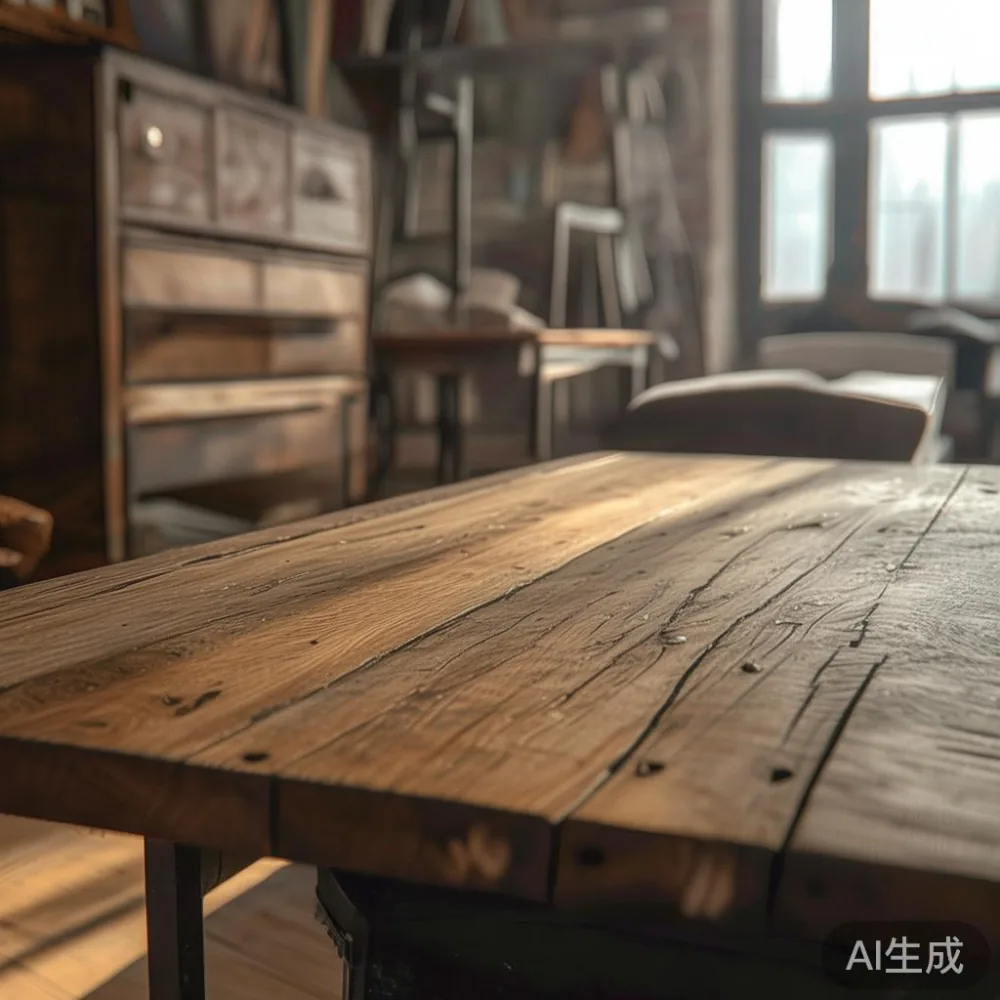
The trick is to choose industrial pieces where at least 60 percent of the visible surface is timber, not metal. A solid wood sofa with a thin steel base — for example, a 2.2 m oak-framed three-seater at 92 cm seat height and 78 cm depth — carries warmth through the timber and lets the steel recede as a line. A solid wood bed frame with an iron headboard grid, mattress base 28 cm off the ground, reads as warm if the slats are oak and the headboard panel behind the grid is fabric. A marble table on a blackened-steel pedestal (60 cm round top, 45 cm height) reads as warm if the marble is a honey Calacatta rather than a stark Statuario.
When I visited a 1,055 sqft Punggol Waterway Crescent unit last month, the homeowner had used exactly this logic. A MIDHILL TV console in 1.8 m reclaimed-oak with a 5 cm blackened-steel plinth sat below a wall-mounted TV. The TV console was the only piece of industrial style furniture in the living room, and it did all the work. The rest of the room stayed soft: a beige boucle two-seater, a curved cream plaster floor lamp, a 2.0 × 1.4 m rug in oat. The room did not feel like a warehouse. It felt like a warm minimal interior with one strong bone.
Which industrial style pieces should you pick first?
In a warm minimal interior, the rule of one anchor per zone works well. Pick one industrial piece for the living zone, one for the dining zone, and one for the bedroom. Anything more and the eye loses its resting point. The usual shortlist:
- Living room anchor — a solid wood sofa or a marble table. A 2.2 m oak-and-steel three-seater is the safer bet for warm minimal; a 1.4 m round marble table with a blackened-steel base works if your TV is wall-mounted and your living room doubles as a reading room.
- Dining room anchor — a 1.6 m to 1.8 m industrial dining table. Six-seater, 90 cm wide, 76 cm high, with a 4 cm thick solid oak top and a trapezoidal steel leg frame. This seats six comfortably and ships in a single 1.85 × 0.95 × 0.18 m crate, which clears every HDB lift I have measured.
- Bedroom anchor — an industrial bed frame. A 1.8 × 2.0 m queen frame in oak with a slim iron headboard, slat base height 32 cm, total weight 58 kg. Two-person carry up a HDB stairwell is realistic; one-person carry is not.
- Secondary pieces — a wardrobe, a nightstand, a TV console. These should echo the anchor's metal finish and timber species but stay quieter. A 1.6 m sliding wardrobe in oak veneer with a black steel handle bar, retailing around SGD 1,650 to SGD 2,400, fits the language without competing for attention.
Note the difference between a European sofa vs Modern sofa: the former tends to carry a higher back, tighter seat depth (60–65 cm), and tailored skirt, while the modern sofa in the industrial style vocabulary is lower (75–80 cm seat height), deeper (85–90 cm), and rests on visible metal. The industrial style sits on the modern side of that line, which is why a European bed vs Mid-century modern bed comparison also works in your favour when you are shopping for a bedroom anchor: the modern bed is closer in geometry to the industrial frame, and therefore easier to harmonise with a warm-minimal palette.
How do you keep a small HDB from feeling crowded with industrial pieces?
Three numbers govern this: negative space, ceiling height, and sight-line. A typical HDB ceiling is 2.6 m, occasionally 2.8 m in newer BTOs. An industrial wardrobe at 2.2 m tall leaves 40 cm of breathing room above; an industrial bookcase at 2.4 m touches the ceiling and visually compresses the room. In a 4-room HDB bedroom of 3.2 × 3.0 m, a 1.8 × 2.0 m bed with two 50 cm nightstands leaves 1.1 m of walkable space on each side and 0.7 m at the foot. That is workable. Add a 1.6 m wardrobe on the remaining wall and the room is full. Do not add a second wardrobe, even if you have the storage need; use under-bed drawers (40 L per side) and a 60 × 40 × 180 cm tallboy instead.
Negative space is the single most important variable. If you cannot see 1 sqm of uninterrupted floor between the bed and the wardrobe, the room is over-furnished. The eye needs that square metre to rest, especially when the furniture is heavy in visual weight. Industrial pieces are heavier in visual weight than their warm-minimal cousins because of the exposed metal, so you need more negative space, not less.
Sight-line matters because HDB flats often have open-plan kitchens, living, and dining within a single 5.5 × 3.6 m zone. Standing at the kitchen counter, you should see the dining table first, then the TV console, then the sofa. If the TV console is 1.8 m wide and the sofa is 2.2 m wide, the dining table should be the same width as the console, or 10 cm narrower, to keep a consistent horizon line. A 1.6 m dining table below a 1.8 m TV console reads as balanced. A 2.0 m dining table below the same console reads as lopsided.
What finishes should you pair with industrial style furniture in a warm interior?
Stick to four finishes per room, and keep two of them timber-adjacent. A safe palette for a warm-minimal flat with industrial style furniture: oak (or light walnut), blackened steel, brushed brass, and one textile (boucle, linen, or wool). The marble table, if you choose one, counts as a fifth finish but should stay in a single block — a 1.4 m round honey Calacatta top on a blackened-steel pedestal. Do not add a second marble surface. The eye will read it as repetition rather than anchoring.
For wardrobes and nightstands, a flat oak-veneer panel with a 1 cm shadow gap and a recessed black steel pull keeps the industrial vocabulary without the visual noise of visible bolts. For the MIDHILL TV console, the same rule applies: a 1.8 m oak top on a 5 cm blackened-steel plinth, no visible hardware, no rivets. The piece does the work by mass, not by detail.
Lighting carries a surprising amount of the warmth. Two 2,700 K picture lights above a 1.4 m sideboard, a 2,700 K floor lamp next to a warm-minimal armchair, and 3,000 K downlights on a dimmer do more for the room's warmth than any finish swap. The blackened steel of an industrial frame will pick up the warm light along its edges, which is the entire effect.
Is industrial style furniture a smart buy for a Singapore climate?
Yes, with two caveats. The first is humidity. A solid wood sofa frame, a solid wood bed frame, and an oak dining table all move with relative humidity. A Singapore flat typically sits between 65 percent and 80 percent RH year-round. Quarter-sawn oak and ash move less than flat-sawn oak, so for a dining table, ask for quarter-sawn or specify a top with breadboard ends. A 4 cm thick oak top with breadboard ends will stay flat through the wet season; a 2.5 cm slab top without breadboard ends will cup, often within 12 months. Most Foshan factories, including the ones MIDHILL works with, will spec a breadboard end on request for an SGD 80 to SGD 150 upcharge on a 1.8 m table.
The second caveat is shipping and stairs. A solid wood bed frame at 58 kg in two cartons is a realistic two-man delivery to a fourth-floor HDB with no lift at the block. The same frame, fully assembled, weighs 58 kg but measures 2.0 × 1.5 × 0.32 m and will not fit through most HDB door frames (0.9 m wide) or any lift under 1.2 m deep. Always ship flat-pack, and always confirm the box dimensions against your lift opening before you confirm the order. Free shipping over US$350 is a common industry line — the equivalent MIDHILL threshold of US$350 is roughly SGD 480, and yes, the bedside nightstand and the dining bench will usually get you over that line for the consolidated order.
Returns and warranty matter because furniture is a long-horizon purchase. A 14-day return window covers the case where the piece arrives damaged or the wrong finish; a 10-year structural warranty covers the case where a joint fails, a slat cracks, or a drawer bottom warps. Lifetime refinishing is the quiet differentiator: 6 to 8 years into ownership, a SGD 280 to SGD 450 refinishing pass at the Foshan workshop will return a worn oak dining top to factory colour, including return shipping. For a Singapore owner, that means sending the top back in a 1.85 × 0.95 × 0.18 m crate via a Singapore-to-Shenzhen freight forwarder at roughly SGD 220 to SGD 320 round-trip. The math works.
Quick reference: the four numbers to check before you order
Before you confirm any industrial style furniture purchase for a Singapore flat, write down these four figures. They will save you the cost of a return.
- Lift opening: width × height in cm. Standard HDB is 1.0 × 2.1 m; newer condos vary. The crate must be at least 5 cm smaller on each axis.
- Door opening at home: width × height. Standard HDB side door is 0.9 × 2.0 m. Solid wood wardrobes over 0.85 m wide will not pass assembled.
- Stairwell turn, if no lift access: measured corner-to-corner. A 1.8 m dining table top will not turn a 1.2 m corner stairwell unless it is hinged or shipped in two halves.
- Ceiling height minus 25 cm: the maximum safe wardrobe height. A 2.6 m HDB ceiling tops out at 2.35 m for a freestanding wardrobe; leave 25 cm for the cornice and the floor tolerance.
Industrial style furniture, sourced from a Foshan workshop with two decades of export experience and shipped flat-pack to your door, gives you the silhouette, the material honesty, and the price point that a warm minimal interior in Singapore actually needs. One solid wood sofa, one industrial dining table, one oak-and-iron bed frame, one marble table or one MIDHILL TV console — picked with their dimensions, finishes, and timber species in mind — will give you the room you want without dragging it toward either a warehouse or a hotel lobby. The palette does the rest.